


MySQL Enterprise Monitor was a tool many database administrators turned to in times of need – that was, until Oracle Enterprise Manager for MySQL came along and stole the show, leading to its phasing out at the start of 2025. Plenty of DBAs have since made the switch to Enterprise Manager, but have you?
If the answer’s ‘no’, I’ll explain why you should make the upgrade, and how to do it.
But first, let’s take a step back and compare the two tools – looking at what they are, and why they’re useful.
While MySQL Enterprise Monitor is phased out (so is no longer supported by Oracle), it is still usable as of the time of writing in 2026 – hence not using the past tense when describing it.
What is MySQL Enterprise Monitor?
If you know your way round MySQL, you’ve likely heard of MySQL Enterprise Monitor – a tool designed to help database administrators with a variety of tasks. Some of its features include:
Query analyzer
Analyze the performance of SQL queries. Useful for learning which queries run on which database, when they were first seen, their latency, affected rows, and more.
Database I/O status page
MySQL Enterprise Monitor comes with a database file I/O (input/output) page, allowing users to filter I/O by file, wait type, or by thread. It also enables DBAs to see what’s happened inside their database in the last hour, 2 hours, 6 hours, 12 hours, the last day, or the past week.
Replication and cluster status page
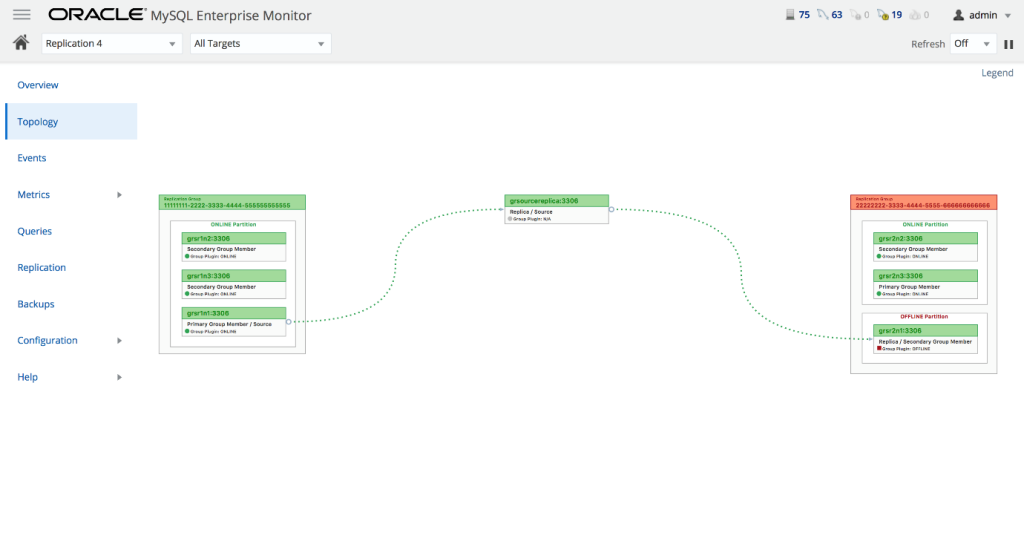
By providing an easy-to-observe topology, MySQL Enterprise Monitor allows developers to see what’s happening with their replication setups.
MySQL Enterprise Monitor backup dashboard
MySQL Enterprise Monitor has a backup section where database administrators can invoke full, incremental, or differential backups of their database instances.
…and more
MySQL Enterprise Monitor came with MySQL Enterprise Edition. It’s just one of many advanced monitoring and management tools available for all kinds of DBAs.
Since, during its lifespan, it was included in MySQL’s enterprise suite of tools, it’s safe to say it had an honorable place in that collection. For many, it provided an easy-to-observe interface into server status, its deep knowledge of MySQL internals ensured accurate intelligence from the start and, with the tool only needing a small footprint on the disk, it quickly became a favorite.
However, it wasn’t perfect. As powerful a tool it was, DBAs had a tough time when they needed to monitor more than a handful of database instances at once, it lacked advanced analytics features, and some of its customization capabilities were a hassle as well.
So, when the improved MySQL Enterprise Manager came along, many DBAs made the switch without hesitation. It was further emphasized in Frederic Descamps’ May 2025 blog post declaring that “MEM is dead, long live Oracle Database Management.”
MySQL schema comparison for faster, safer deployments
What is Oracle Enterprise Manager for MySQL?
After Enterprise Monitor’s discontinuation, MySQL now offers two options for you to choose from: Oracle Enterprise Manager for MySQL, or Oracle Cloud Infrastructure (OCI) Database Manager.
Oracle Enterprise Manager for MySQL is a tool built for large-scale MySQL deployments. Also referred to as EM4MySQL, it offers advanced analytics (query fingerprinting, customizable dashboards, etc.), automation (auto-tuning, scheduled maintenance, healing), and integrations (connectors for Oracle Enterprise Manager, Prometheus, and Grafana).
Oracle Enterprise Manager for MySQL vs MySQL Enterprise Monitor – which is best?
Let’s now compare the two tools directly:
| Feature | MySQL Enterprise Monitor | MySQL Enterprise Manager |
| Scalability | Scalable, can deal with projects necessitating tens of database instances. | Very scalable, designed for large-scale (hundreds of database instances) deployments. |
| Available features | Query analyzer, I/O and replication status pages, backups, basic alerts, monitoring. | Advanced analytics (connections, response times, transactions and statements, rows read via scanning/indexes, etc.), automation, integrations (Grafana, Prometheus…), advanced compliance statistics. |
| UX | UX is modern and familiar to many DBAs and beyond. | UX is modern and familiar. At the same time, pretty rich in features – takes some time to get used to. |
| Integration ability | N/A | Seamlessly integrates with connectors for Oracle Enterprise Manager, Prometheus, Grafana. |
| Security | Supports TLS, role-based access control (RBAC), integrates with MySQL user accounts. | Supports MFA, TLS, built to integrate with existing enterprise security features. Provides comprehensive auditing features. |
| Pricing | Comes with a subscription-based model and the pricing is based on monitored database instances. | Comes with a licensing model – you can pay per user or per hardware resources used. Comes with a subscription-based or perpetual licensing, depending on your requirements. Also, you can choose from a per-database or per-deployment licensing model. |
As you can see, the advantages of MySQL Enterprise Monitor include its query analyzer, I/O status page, replication and clustering status page, and its ability to conveniently take backup copies of your database when necessary. Many DBAs got used to – and enjoyed – these features.
In comparison, Oracle Enterprise Manager for MySQL is more scalable, can be integrated with a variety of tools, comes with a better-looking UX, and has a richer set of features in general.
Oracle Enterprise Manager for MySQL or MySQL Enterprise Monitor – which should you use?
If your environment is growing, or if your team only needs basic monitoring (without, for example, any integration with Prometheus or other tools), there’s no need to switch to Oracle Enterprise Manager for MySQL just yet. The older MySQL Enterprise Monitor will still be fine for you.
However, if your database environment is growing significantly, you’re looking for automated tuning suggestions, self-healing, and high-performance monitoring, it may be wise to switch to Oracle Enterprise Manager for MySQL instead.
While it does require some getting used to, it is extremely scalable and comes with many advanced analytics-related features for queries, indexing, connections, and more. It also integrates seamlessly with modern tools like Prometheus and Grafana, and supports advanced security features not supported in Enterprise Monitor.
One last thing…
If your monitoring needs extend beyond MySQL — let’s say, a mixed estate with SQL Server or PostgreSQL — a cross-platform tool like Redgate Monitor is worth a look, since it covers MySQL alongside other engines from a single pane of glass.
Future-proof database monitoring with Redgate Monitor
This document contains proprietary information and is protected by copyright law.
Copyright © 2026 Red Gate Software Limited. All rights reserved




Load comments